
Table of Contents
SEO Is a Full-Picture System, Not a Single Channel
One of the biggest mistakes businesses make is assuming SEO lives only on their website. It does not. Modern SEO is the sum of:
- Website structure, speed, and content
- Ongoing content creation and topical authority
- Google Business Profile optimization
- Reviews and reputation signals
- Social media activity and brand engagement
- Citations, backlinks, and digital mentions
- User behavior signals like click-through and dwell time
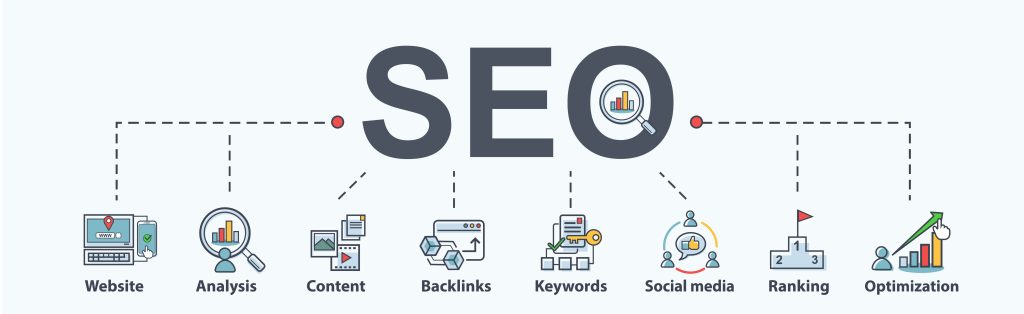
This is why organic SEO services that focus on only one area often fail to deliver sustainable growth. SEO works best when it is treated as a digital ecosystem, not a checklist. Each element strengthens the others. Content feeds social. Social increases branded search. Branded search improves trust. Trust improves conversions. Conversions reinforce ROI.
Growth Projection: The Missing SEO Conversation
Most SEO discussions focus on rankings. Rankings are a means, not the outcome. What actually matters is growth projection. Growth projection answers questions like:
- What happens if we add four new optimized pages per month?
- How does increasing content velocity affect traffic after 6–12 months?
- What happens when reviews and social engagement improve alongside content?
- How does compounding traffic affect lead volume and revenue?
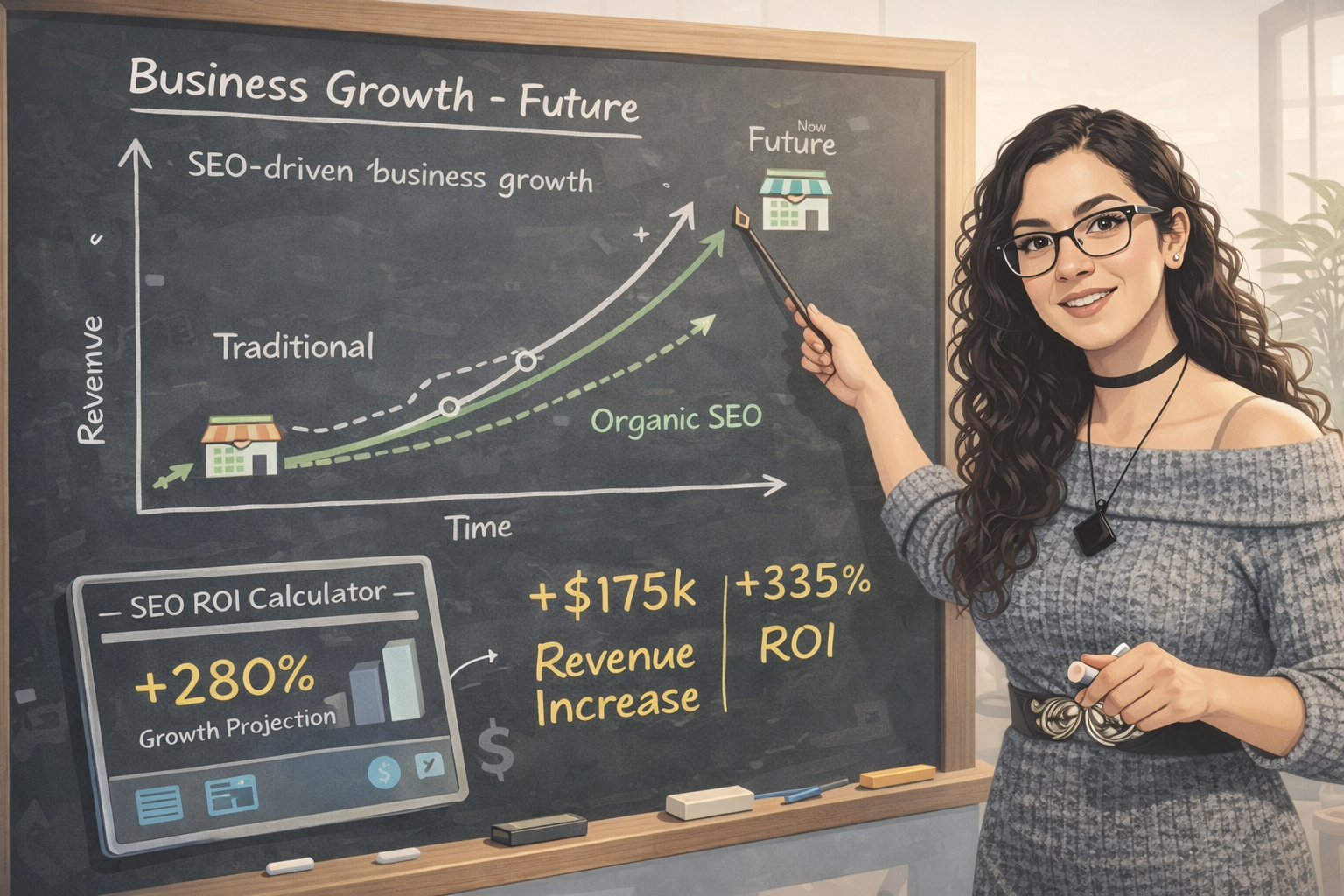
An SEO ROI calculator allows you to model these scenarios instead of guessing. Small changes made consistently over time do not produce linear results.
They produce exponential ones. This is why businesses that commit to long-term organic SEO services often outperform competitors who rely on short bursts of activity.
SEO ROI Calculator
Click the image to access the SEO ROI Calculator and explore how different strategies, timelines, and investment levels can impact growth based on your specific business goals and budget.
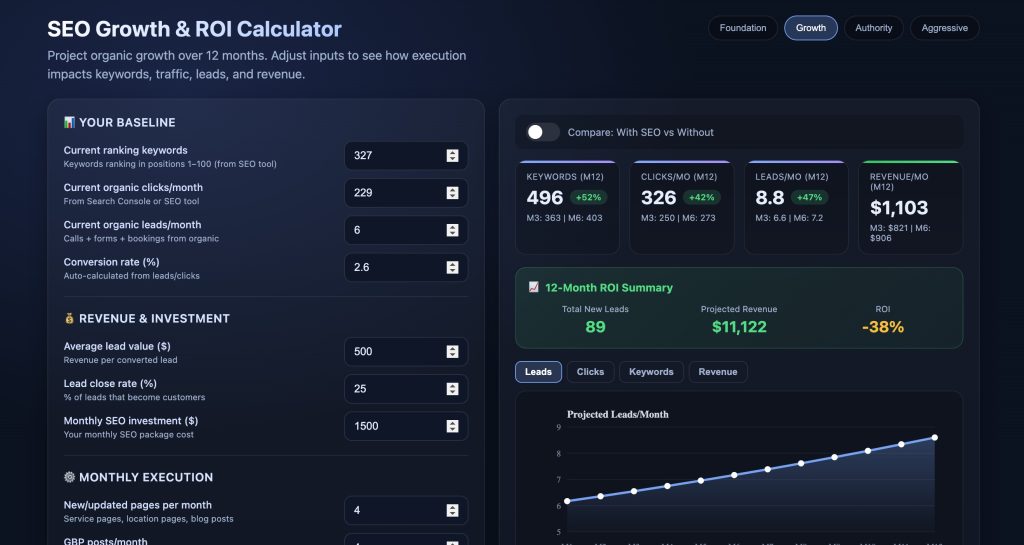
SEO is not one-size-fits-all. Every business starts from a different position and operates in a different competitive environment. Some companies may need to accelerate content production, authority building, or supporting channels more aggressively than others to see meaningful results. Outcomes can vary widely depending on industry, location, competition, current website health, and existing digital footprint.
The calculator is designed to help model potential growth scenarios, not to guarantee results. Actual performance will always depend on how SEO efforts are executed, how competitive the market is, and how consistently supporting activities such as content, social engagement, and business listings are maintained over time.
How SEO Professionals and Business Owners See ROI Differently
SEO professionals tend to think in terms of:
- Keyword coverage
- Indexation
- Crawl efficiency
- Authority building
- Content depth and internal linking
Business owners think in terms of:
- Leads
- Revenue
- Cost vs return
- Sustainability
- Brand visibility
Both perspectives are valid. The disconnect happens when no framework exists to connect technical work to financial outcomes. That’s where ROI modeling matters. It translates technical SEO decisions into business-level impact without stripping away complexity.
SEO Builds a Digital Footprint, Not Just Traffic
A strong SEO strategy doesn’t just increase traffic. It increases your digital footprint. That footprint includes:
- More branded searches
- Higher trust with search engines
- Greater visibility across platforms
- Increased likelihood of referrals and mentions
- Stronger conversion rates over time
The larger your footprint, the harder you are to replace or outrank. This is why SEO should be evaluated over quarters and years, not weeks. When SEO is done correctly, it becomes one of the highest-ROI marketing investments a business can make.
The Role of AI SEO in Modern Search Visibility
SEO is no longer optimized only for human readers or traditional search engine crawlers. Today, search visibility is increasingly influenced by AI-driven systems that evaluate content quality, relevance, intent alignment, and entity relationships at scale. AI SEO refers to optimizing your digital presence so that machine learning models can correctly interpret, categorize, and trust your business across search engines, AI summaries, and generative search experiences. This includes:
- How clearly your services, location, and expertise are defined
- How consistently your brand appears across platforms
- How well your content answers real questions, not just keywords
- How user behavior reinforces relevance and trust signals
Search engines now rely heavily on AI to determine which businesses are authoritative enough to surface, summarize, or recommend.
AI SEO Is About Interpretation, Not Manipulation
A common misconception is that AI SEO is about “gaming” algorithms. It isn’t. AI systems are designed to reduce manipulation, not reward it. They prioritize:
- Clear topical authority
- Consistent messaging across your website, listings, and social platforms
- Structured data and clean site architecture
- Content that demonstrates expertise, experience, and intent alignment
Businesses that try to shortcut SEO with thin content or isolated tactics often struggle because AI systems look at the entire digital footprint, not just individual pages. This is why organic SEO services must now account for AI interpretation across:
- Search results
- Local listings
- Social platforms
- Knowledge panels
- AI-generated summaries and recommendations
How AI SEO Connects to Growth Projection and ROI
AI-driven search systems amplify compounding effects. When your content, listings, and engagement signals align, AI systems become more confident in your relevance. That confidence leads to broader visibility, stronger placement, and increased trust, which in turn improves click-through rates and conversions. This is where growth projection becomes critical. Small increases in clarity, consistency, and authority can produce outsized long-term gains because AI systems scale trust faster than traditional ranking models ever could. Using an SEO ROI calculator helps illustrate how incremental improvements in content velocity, engagement, and supporting channels can compound into meaningful business growth over time.
Why AI SEO Makes “One-Size-Fits-All” SEO Impossible
AI-driven evaluation makes blanket SEO strategies ineffective. Different businesses require different levels of acceleration based on:
- Industry competitiveness
- Geographic market density
- Existing authority and visibility
- Brand recognition
- Content maturity
A local service provider and a national e-commerce brand will not require the same strategy, pacing, or investment to see results. AI systems evaluate each business within its own competitive context. This is why results vary and why projections must be adjusted per business rather than treated as guarantees.
SEO in the AI Era Is a System, Not a Tactic
AI SEO reinforces what modern SEO has already become: a connected system. Website optimization, content creation, social signals, reviews, and business listings no longer operate independently. AI systems assess how well these pieces work together to represent a credible, authoritative business. Businesses that embrace SEO as a long-term, system-based investment are the ones most likely to benefit from AI-driven visibility now and in the years ahead.
Measuring What Actually Matters
SEO does not fail because it “doesn’t work.”
It fails because it is misunderstood, underfunded, or evaluated incorrectly. Using an SEO ROI calculator allows businesses to:
- Set realistic expectations
- Understand time-based growth
- See how different efforts stack together
- Make informed investment decisions
SEO is not magic. It is math, strategy, and consistency applied over time. And when viewed as a full-picture system, the ROI becomes clear.


0 Comments