

Most SEO advice stops at surface metrics. Rankings. Traffic. Keyword counts.
That phase is fine if your site is invisible. But once a website starts ranking and growing, those numbers stop being answers and start being distractions.
At Ravenous Raven Design, the difference between beginner SEO and expert SEO is simple:
Beginners ask what happened.
Professionals ask why it happened, whether it matters, and what breaks next if they’re wrong. They don’t stop at outcomes. They interrogate causes. They ask better questions to uncover real problems, not just visible symptoms. This curiosity makes them proactive instead of reactive, allowing them to anticipate issues, adjust strategy early, and solve problems before they become costly.
If your website is indexed, ranking, and gaining traction, these are the questions you should be asking to move from growth to leverage.
If you’re newer to this side of SEO, start here: What Are Organic SEO Services?
Table of Contents
1. Search Reality Checks: Are We Solving the Right Problem or Just Collecting Traffic?
If these answers are wrong, everything else is theater.
- What percentage of our ranking keywords have real commercial intent, not just curiosity?
- Which keywords look high intent but are actually garbage because they convert poorly once traffic arrives?
- Which keywords attract people who want to learn, not buy, book, or call?
- Which keywords feel valuable in tools but collapse the moment real users land on the page?
- Which keywords are ranking only because competition is weak, not because they’re worth money?
- Are we accidentally training Google to see us as an informational site instead of a business?
Google’s own explanation of how search works makes it clear why intent matters: How Google Search Works
2. Page Performance Questions: Pages Matter More Than Domains
Domains don’t rank. Pages do.
- Which pages generate 80% of impressions?
- Which pages rank for dozens of keywords but are functionally useless because they drive no action?
- Which pages sit at positions 4–12, close enough to win but ignored long enough to rot?
- Which pages are indexed but receive zero impressions, signaling Google doesn’t know what to do with them?
- Which pages rank well but show poor engagement, telling Google users didn’t get what they came for?
- Which pages cannibalize each other and dilute relevance?
- Which pages exist only because someone once said “SEO best practice,” not because they serve a purpose?
If you’ve ever wondered whether spreading content across multiple sites helps or hurts, read this first: Does It Help My SEO to Use Multiple Websites?
3. Indexing & Crawl Control: Google Attention Is Finite
Being ignored by Google is worse than being disliked.
- How many indexed pages are actually earning impressions?
- Which pages get crawled repeatedly but never rank, indicating wasted crawl budget?
- Are important pages buried behind unnecessary navigation layers?
- Are parameters, tags, or filters quietly eating crawl resources?
- Is indexation intentional or accidental?
- Which pages would improve fastest if Google crawled them more often?
Helpful Google references:
Index Coverage,
Crawl Stats
4. Ranking Mechanics: If You Can’t Explain Movement, You’re Guessing
- When rankings improve, what changed first: content, links, internal links, or engagement?
- Are gains happening site-wide or isolated to specific pages?
- Does volatility cluster around certain content types?
- Which competitors gained rankings without publishing new content, and why?
- Which improvements align with query refinement instead of authority growth?
- Are we winning because we’re better, or because others stopped trying?
For a plain-English overview of SEO fundamentals: What Is SEO?
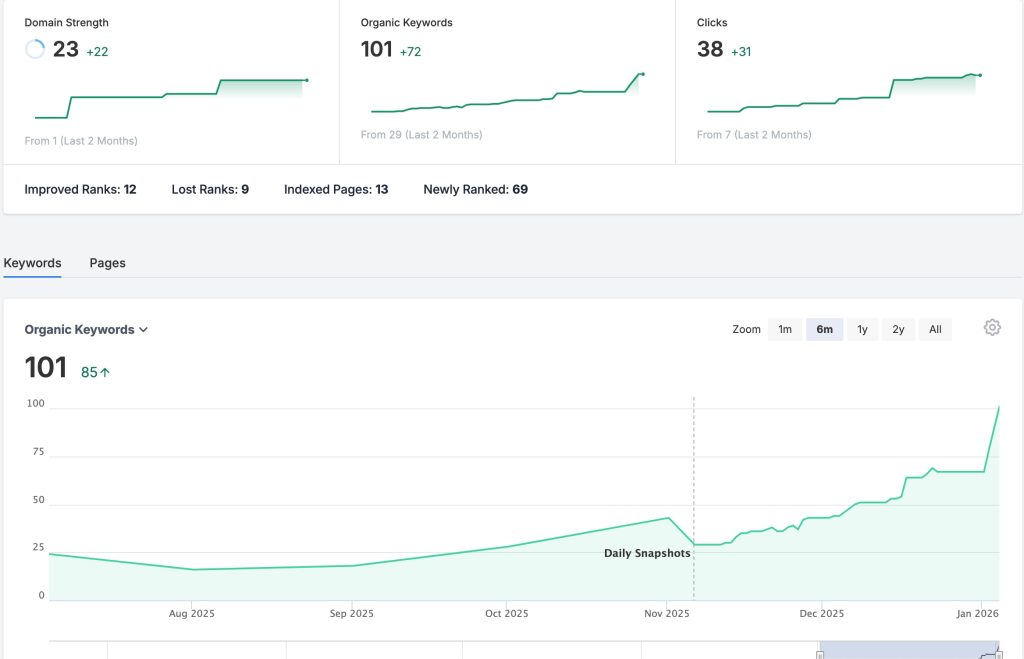
5. CTR & SERP Ownership: Ranking Without Clicks Is Just Decoration
- Which page-1 keywords have bad CTR, making the ranking effectively useless?
- Are titles written for humans or for keyword checklists?
- Are clicks being siphoned by featured snippets, local packs, People Also Ask, or ads?
- Which SERPs are so crowded that ranking doesn’t justify the effort?
- Where should we intentionally avoid ranking because the SERP is hostile?
CTR data lives here: Search Console Performance Reports
6. Intent Alignment: This Is Where Most SEO Fails
Google ranks intent matches, not keywords.
- Does the page format match what Google already favors in the SERP?
- Are we answering the query too broadly, confusing users?
- Are we answering it too narrowly, leaving users unsatisfied?
- Are we mixing multiple intents on one page and confusing Google?
- Which pages should be split, merged, or removed entirely?
Platform choice matters too: WooCommerce vs Shopify
7. Internal Linking & Authority Flow: Backlinks Bring Power In, Internal Links Decide Where It Goes
- Which pages receive the most internal link equity?
- Are we reinforcing revenue pages or wasting links on low-value content?
- Which high-authority pages should redistribute power?
- Are links placed for convenience or ranking strategy?
- Which pages would move fastest with 5–10 strategic internal links?
8. Content Efficiency: More Content Is Usually the Wrong Answer
- Which pages deliver the highest keyword-per-page ratio?
- Which pages rank for one keyword and nothing else, making them inefficient?
- Are we publishing content Google already has 10,000 better versions of?
- Which pages are doing the work of three and should become templates?
- What content should be refreshed instead of rewritten?
9. Conversion & Revenue Reality: SEO Exists to Make Money
Traffic without conversion is cosplay.
- Which organic pages generate leads or sales?
- Which pages attract the wrong audience, forcing education instead of closing?
- What is our organic customer acquisition cost?
- Which keywords produce calls, which produce forms, and which produce nothing?
- Are we optimizing for rankings the business can’t monetize?
- Where does organic traffic die in the funnel?
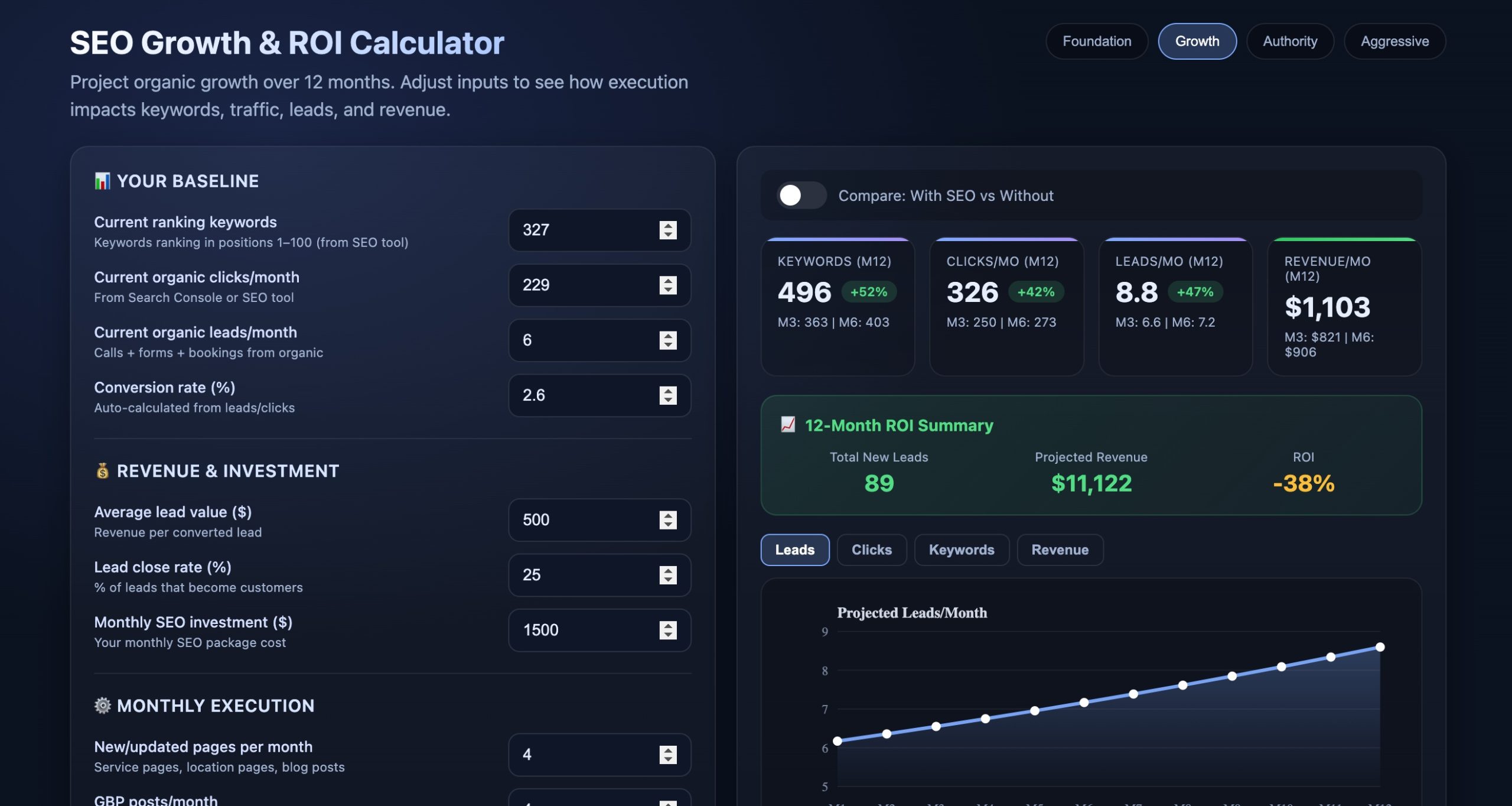
The goal of SEO for a business is to improve your return on investment. You can use my custom SEO ROI Calculator to estimate projection growth for up to 1 year. You can also read up on SEO ROI explained simply by expert Neil Patel.
10. Risk & Sustainability: Experts Plan for Downside
- How dependent is growth on a small cluster of keywords?
- What happens if one core page drops?
- Which rankings exist only because competitors are asleep?
- Which pages would collapse if Google tightened intent matching?
- Which traffic gains are borrowed and which are earned?
11. Strategy-Level Questions: The Line Between Execution and Leadership
- What should we stop doing?
- Which SEO activities produce diminishing returns?
- Where does SEO overlap with CRO, paid media, PR, or product?
- Which metrics actually matter to the business owner?
- What is the single bottleneck limiting growth?
- If SEO effort was cut in half, what would remain?
Final Thought
Expert SEO isn’t more tools, more audits, or more content.
It’s judgment.
Judgment about intent.
Judgment about leverage.
Judgment about what’s garbage and why.
At Ravenous Raven Design, we treat SEO as infrastructure. When the foundation is right, growth compounds. When it isn’t, no amount of content fixes it.
This is where SEO stops being busywork and starts being decisive.
What questions should I ask about SEO?
The most important SEO questions are not about rankings alone. You should be asking how SEO supports revenue, intent alignment, and long-term growth.
Key questions include whether your keywords have real commercial intent, whether your pages convert once traffic arrives, how Google is interpreting your site, and where SEO effort is being wasted. If SEO activity can’t be tied back to business outcomes, it’s usually noise.
What questions should I be asking an SEO company before hiring them?
Before hiring an SEO company, you should ask how they measure success, how they define “good” traffic, and how they decide which keywords are worth pursuing.
You should also ask how they handle low-converting keywords, how they approach internal linking, and how they prove SEO ROI over time. Any company that avoids these questions or answers only in rankings should be treated cautiously.
What questions do you ask when recruiting or hiring an SEO director?
When recruiting an SEO director, the most important questions focus on judgment, not tools.
Ask how they decide which pages deserve authority, how they diagnose ranking drops, how they handle keyword cannibalization, and how they explain SEO performance to non-technical stakeholders. Strong SEO leaders can explain cause and effect clearly, not just report metrics.
How do you handle tough SEO questions from clients?
Tough SEO questions usually arise when expectations were set incorrectly.
The best way to handle them is to anchor discussions in intent, conversion data, and tradeoffs. This means explaining why some keywords are garbage because they convert poorly, why not all traffic is valuable, and why SEO growth is non-linear. Transparency builds more trust than optimism.
How should I answer SEO questions in an interview?
When answering SEO questions in an interview, focus on reasoning instead of tactics.
Explain how you evaluate intent, how you decide which pages to optimize, how you identify wasted effort, and how you measure success beyond rankings. Interviewers looking for senior SEO talent are listening for decision-making frameworks, not memorized definitions.
What are the most common SEO questions people ask online?
Most SEO questions asked online focus on rankings, traffic, and timelines.
More advanced questions revolve around why pages rank but don’t convert, how Google interprets intent, why traffic drops suddenly, and how internal links affect performance. These deeper questions usually indicate a site has moved beyond beginner SEO problems.
What questions should business owners ask their SEO provider?
Business owners should ask how SEO connects to leads, sales, or bookings.
Important questions include which pages drive revenue, which keywords waste time, how SEO priorities are chosen, and what happens if rankings change unexpectedly. If an SEO provider cannot explain these clearly, they are likely executing tasks instead of managing strategy.
What is the best way to think about SEO questions as a beginner?
Beginners should start by asking why SEO works, not just how.
Instead of focusing on isolated tactics, beginners should learn how intent, content quality, internal links, and user behavior work together. Asking “why did this rank” is more valuable than asking “what plugin was used.”



0 Comments