

Table of Contents
Does It Help My SEO to Use Multiple Websites?
Short answer for local businesses: No.
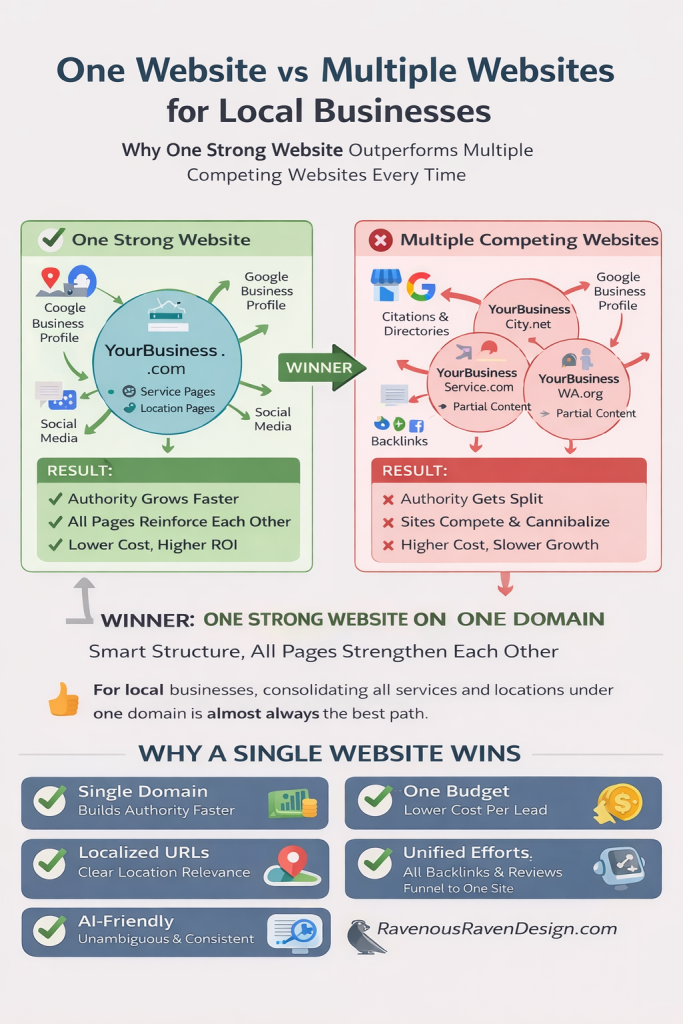
Long answer: Using multiple websites usually hurts your SEO, increases costs, and slows growth unless there is a very specific, strategic reason to do it.
For most local businesses, one strong website on a single domain is far more effective than trying to manage several sites that compete with each other.
Why Local Businesses Are Tempted to Create Multiple Websites
Local business owners often create multiple sites because they believe:
- More websites means more chances to rank
- Separate sites help target different cities or services
- Multiple domains will dominate search results
On paper, this sounds logical. In practice, it almost always backfires.
Search engines do not reward the number of domains you own. They reward clarity, authority, and consistency.
How SEO Actually Evaluates Your Business
Search engines and AI-driven search systems evaluate your business at a domain and entity level, not just page by page.
They look at:
- Which site represents the real business
- Where authority and trust are concentrated
- How consistent your services, location, and branding are across the web
- How users engage with your content
When this information is split across multiple websites, search engines receive mixed signals instead of strength.
The Core Problem: Self-Cannibalization
When multiple websites target the same services, locations, or keywords, they do not help each other. They compete against each other.
This is known as keyword and authority cannibalization, and it is one of the most common SEO mistakes local businesses make.
Instead of one site becoming clearly authoritative, none of them fully are.
One Strong Website vs Multiple Websites for Local Businesses
| Factor | One Strong Website | Multiple Competing Websites |
|---|---|---|
| Domain Authority | Compounds over time | Split across domains |
| Keyword Rankings | Stabilize and improve | Fluctuate or stall |
| Backlinks | All strengthen one site | Diluted and fragmented |
| Google Business Profile Alignment | Clear and consistent | Confusing signals |
| Cost | Lower long-term cost | Higher ongoing costs |
| Maintenance | Centralized | Duplicated work |
| AI Search Interpretation | Clear business entity | Ambiguous entity signals |
| ROI | Predictable and compounding | Slower and inconsistent |
Why This Matters Even More for Local SEO
Local search demand is finite.
There are only so many people searching for services like:
Creating multiple websites does not create more demand. It splits the same demand across weaker assets.
Search engines prefer one clear business with one authoritative website supported by strong location and service pages.
The Smarter Alternative: One Domain with Strategic Structure
Instead of building multiple websites, local businesses should focus on:
- One primary domain
- Service-specific pages
- Location-based pages
- Supporting content hubs
Example structure:
- yourbusiness.com/plumbing-spokane
- yourbusiness.com/drain-cleaning-spokane
- yourbusiness.com/emergency-plumber-spokane
This approach builds authority faster, avoids internal competition, and makes scaling easier.
AI SEO Makes Multiple Websites Even Riskier
Modern search is increasingly powered by AI systems that prioritize:
- Consistency
- Clear business identity
- Unified authority
- Trust signals across platforms
Multiple overlapping websites introduce ambiguity. AI systems do not reward ambiguity. They suppress it.
A single, authoritative domain is easier for AI to understand, trust, and surface in search results.
When Multiple Websites Might Make Sense
There are limited cases where multiple websites are appropriate:
- Completely separate businesses
- Different legal entities
- Distinct branding and audiences
- Non-overlapping services or locations
If the websites share the same phone number, address, services, or branding, they should almost always be consolidated into one site.
Bottom Line for Local Businesses
Using multiple websites does not improve SEO for most local businesses. It usually:
- Splits authority
- Increases costs
- Slows growth
- Confuses search engines
- Reduces return on investment
One strong website builds trust faster, compounds SEO value, scales cleanly, and performs better in AI-driven search.


0 Comments